After doing a similar analysis project in my IP course, “Approaches to Digital Humanities,” I decided to create data visualizations to analyze at the scripts, descriptions, and character relationships of the Fox TV show, New Girl.
In creating my corpus, I was really interested in a few things. The first was character names and descriptions. I looked at how often they appeared, and how often they were related to others. I was looking to analyze the relationship between the roommates throughout the show, along with their different relationship histories. Specifically, my main objective was to see whether or not it was possible to predict the ending of Season 6, where Jess and Nick end up together.
Below are the Voyant visualizations:
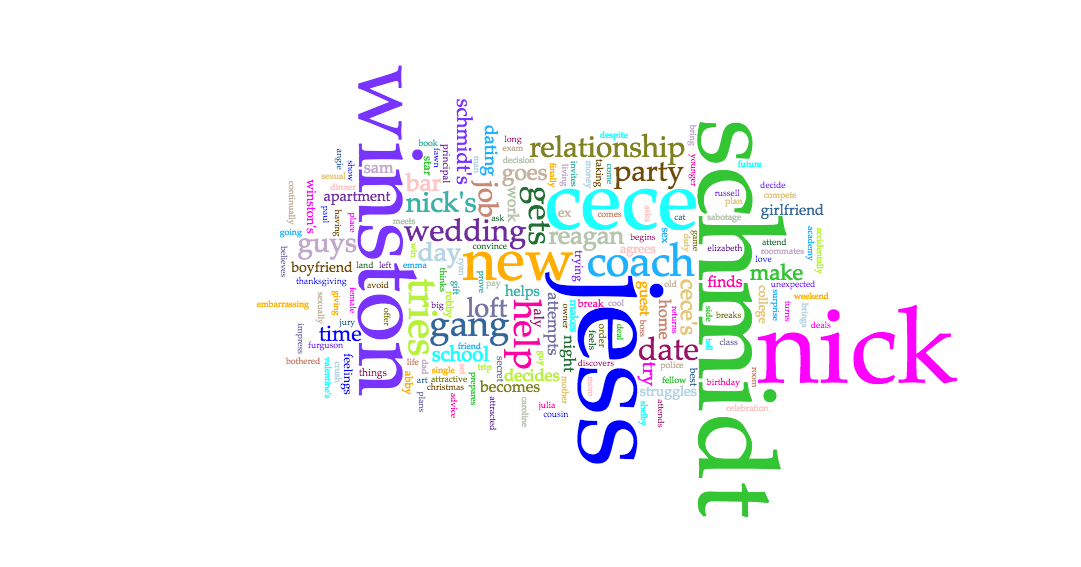
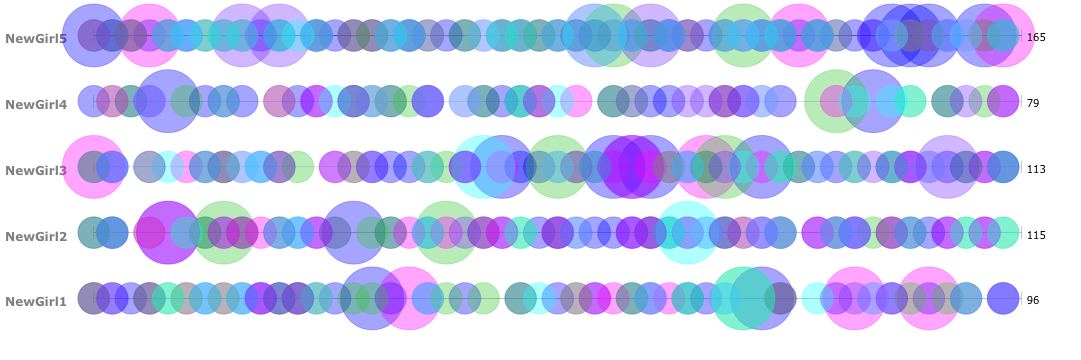
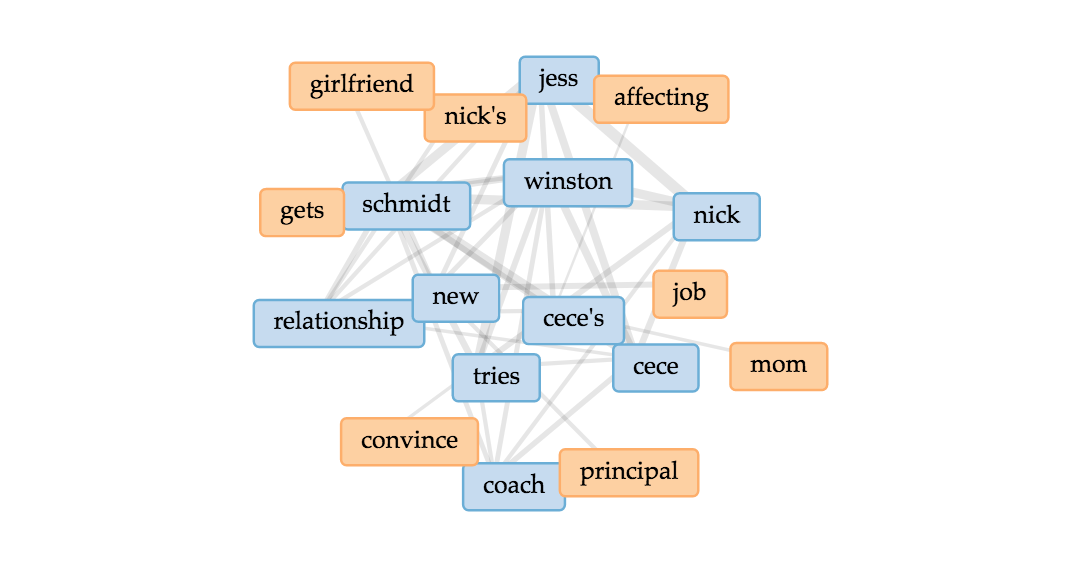
In analyzing the character frequencies and relationships, I found Voyant extremely useful. The Cirrus tool was interesting to use. Immediately, I found that the most frequent words are the main characters of the show, including Jess, Nick, Schmidt, Winston, Cece, and Coach. Through the Bubblelines, I was able to see the overlap and frequencies over time of when these individual characters were mentioned throughout the seasons. And then lastly for Voyant, I used the Links, which was a good visual of the various connections between key terms, and it supports the strong link between Jess and Nick in the texts.
The Voyant tools, including Cirrus, Bubblelines, and Links tools, were extremely helpful in analyzing the text across the different seasons in showing trends and connections throughout. One tool that I believed would have worked in my favor is the Phasing tool. I struggled with this tool many times, and tried to get it to behave properly, however it wasn’t very user friendly and resulted in poorer results that what I had expected. One tool that I would have loved, that would have been slightly more advanced would be a stronger linking tool. I would have loved to see how words were more intertwined with one another than just the Links tool was capable of showing. Lastly, it would be useful for the Voyant Tools to interpret different versions of words or understand synonyms when analyzing how frequent similar themes or messages appeared.
Below are the Jigsaw Visualizations:
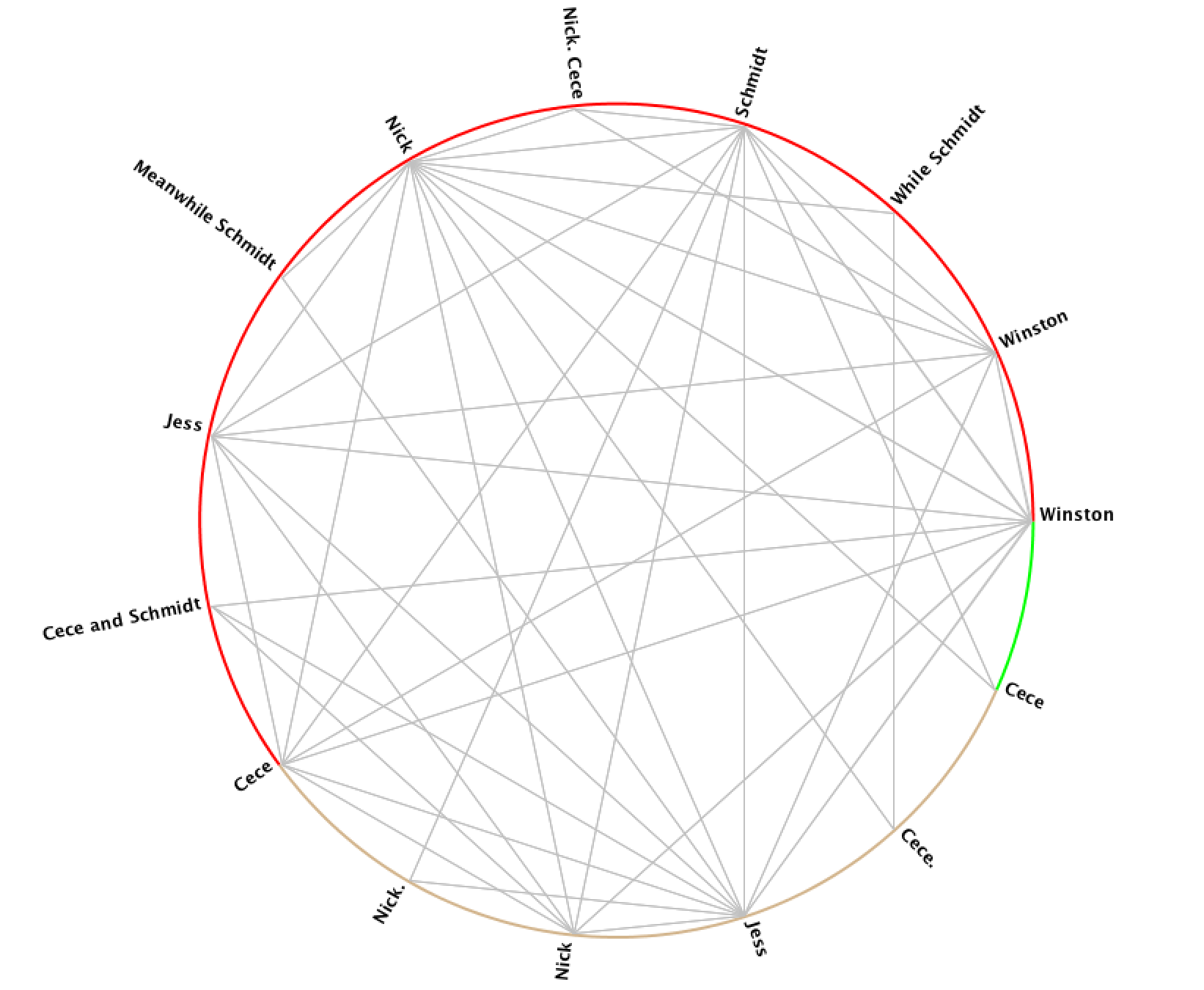
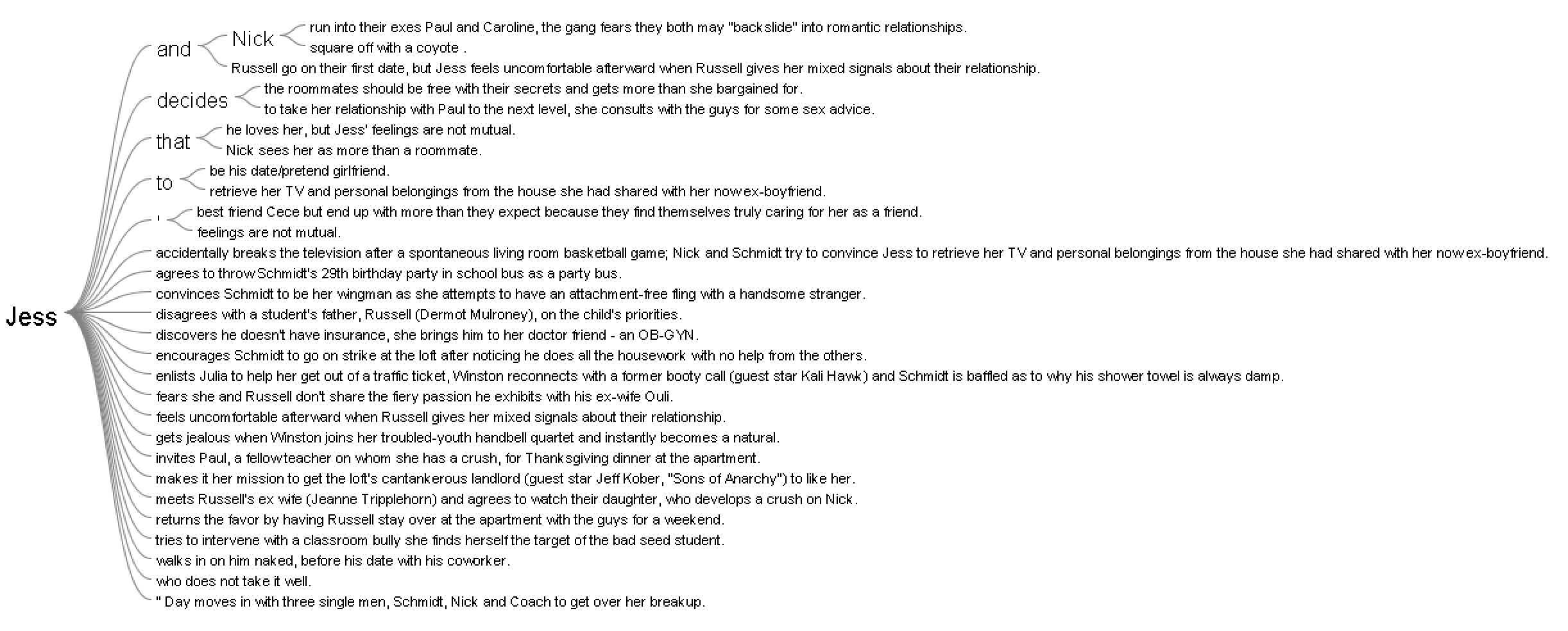
In using Jigsaw, I utilized the Word Tree and Circle Graph tools to look at the various connections between the characters. From the Word Tree, it is clear that “Jess and Nick” is a reoccurring phrase, and it nicely shows how Nick is mentioned in sentences that relate to Jess. One further investigation that would be interesting to follow up on this would be to see what words and phrases are before the term “Jess.” In addition to the Word Tree, the Circle Graph creates a pleasing web of connections between the various characters. However, it’s unclear exactly how and why the character names are divided the way they are between the different “groupings” on Jigsaw. Another flaw is that the visualization doesn’t portray the strength of the connection between characters, which I would have loved to see.
Overall the process of analyzing the data was an enjoyable one, but I would be interested to look deeper into the written scripts themselves, rather than just the summaries that were short and necessary for Jigsaw.
In comparing the two platforms, Voyant was more useful in terms of making sense of and creating the visualizations. Jigsaw was not nearly as user-friendly, and the graphics weren’t of the same caliper as Voyant. That being said, with other data, Jigsaw could be more beneficial if there were more layers and details about the time, place, and location of the data.
Overall, the process of creating the corpus and visualizations has been an amusing experience. As Tanya Clement discussed, the creation of these visualizations gave new insight, and a “vantage point” that allowed me to see the text from a different angle. Additionally, with the text simplified down to significant words and connections, the visualizations allowed for “a feeling of justice of authenticity that is based on plausible complexities, not just simple immutable truths.”