For my corpus, since I’m interested in music, I’ve decided to focus my research on the lyrics of some of the artist I like to listen to. I grew an interest in music because I find it as a way to express oneself. I’ve realized this is a very broad topic so instead, I choose songs that have some type of correlation, rap. I then went on to Genius and copy and pasted my top 10 songs and put them in a single word document. With the text, I gathered I hope to find similarities between these songs whether it’s the deeper message the artist is portraying, commonly used words, or to analyze and see if their flows are the same. At first, I was going to censor the explicit words from these songs however I felt that was taking away from the authenticity of these raps. I want the viewers of my corpus to get a sense of what artist are rapping about today whether it’s money, drugs, women, etc.
Unfortunately trying to download jigsaw to my computer has been a mess this past couple of weeks. My system since trying to download the program has not been right since. So for the assignment write up, I’m currently using WebJigsaw. I realize not using the original jigsaw I’m not able to see the many interactive visualizations however it still provides me with the word tree, list, and document grid views.
Nonetheless, from interacting with these two visualizations I’ve realized they are quite similar. However rather than just being user-friendly and more appealing like Voyant, Jigsaw takes it a step further by using visualizations that show connections between entities across the document collection.
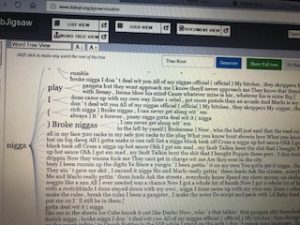
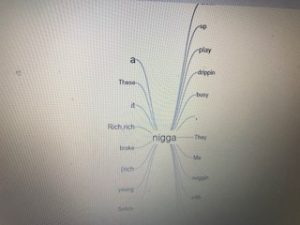
Both tools have a word tree visualization, however, spits out different information when searching for the same root term. The term ”ni**a” was used both in voyant and jigsaw to show an example of this. On the one hand, when using voyant to search for a term you are able to click on the term your searching and it will allow the viewer to explore the root term and the different phrases its used in throughout the corpus. On the other hand, when a person is using jigsaw’s wordtree the viewer is able to search for a term and it will turn show you the entire phrase that follows the word your searching for as well as highlight/bold words that are used more frequently throughout your corpus.
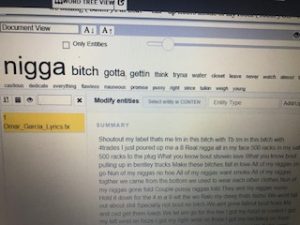
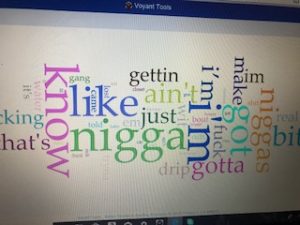
Furthermore, both tools have similar visualizations that enable the viewer to see the top frequent words being used in the document. This tool is used to quickly draw the attention of the viewers to show them what is in the document. With voyant, this tool is called cirrus which uses a method where the most commonly used words are positioned in the middle emphasized with larger text and the less frequently used words are on the outside hovering around. In a jigsaw, this tool is called the document view which has all the traits that cirrus has but you can take it a step further by analyzing the similarity of your documents against the others being visualized in addition you can request that the document execute a sentiment analysis.
By constructing my corpus and viewing it through both visualization tools: voyant and jigsaw I believe it gave me a different perspective. This, in turn, agrees with what Tanya Clements harped on when she talked about multi-viewpoints. Even though I wasn’t able to use the original jigsaw format I got the sense of how powerful of a tool the program really was through WebJigsaw. What drew my attention from using both visualizations were how interactive they both were in using my corpus. Using both visualizations I was able to catch things that the human eye might not. I was able to break down the information and get a better sense of the lyrics of my favorite songs.