For this assignment, I decided to look at the last words of all death row inmates in Texas from 1982 to now. Although I knew working with this corpus would be depressing, being able to analyze their last words was extremely interesting and it gave me valuable insight into their experiences on death row. Creating my corpus was extremely tedious because the website where I acquired all the information was separated into over 548 links. I tried to use web scraping tools, but was not able to figure out how to arrange the data in a way that would upload to Jigsaw so I decided to put all the information into separate TextEdit files myself. This took me a long time to do, but it all worked out in the end!
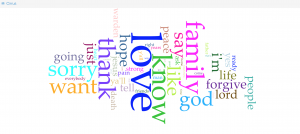
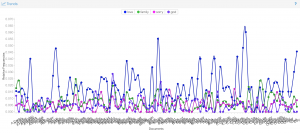
First, I analyzed the corpus through Voyant. This was very interesting to look at because the Cirrus tool allowed me to see the most commonly used words. I noticed that they are all positive words that focus on relationships of some sort, whether that relationship is with family, a friend, or a religion. I found it strange that many of the prisoners said thank you in their last words given their situation (I noticed this as I was reading through the last words during the construction of my corpus as well). The Trends tool allowed me to visualize the patterns of the last words more easily. The relative frequency for words like “family” and “love” were much higher than repentant words such as “sorry”. Looking at the trends led me to believe that the prisoners focused more on reaffirming their love one last time rather than focusing on what they did in the past that led to that moment. I think this shows that many of the prisoners significantly change as they await their death to the point where they are almost completely different people when their execution date comes along.
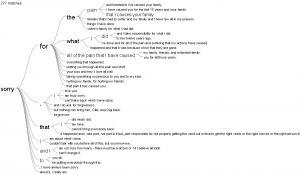
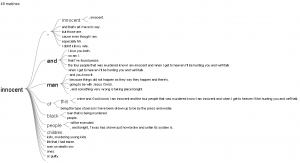
Next, I used Jigsaw. I really liked the Word Tree view and the List view. I tested out several different words in the Word Tree view and was able to better understand the context and the meaning intended by the different prisoners. I thought it would be interesting to look at the word “innocent” because it was not very common. If prisoners were using their final moment to state their innocence, I concluded it was because they were either innocent or they were lying and therefore have not come to terms with their crimes like so many of the others had. I also used the List view, which was interesting because it showed the connections between the entities as well as the frequencies. This tool really highlighted the prisoners’ acknowledgment of various faiths and their hope for an afterlife. This helped me better understand the context and the relationship between the words they chose. I liked that this view was interactive and allowed you to look at the information in a variety of ways.
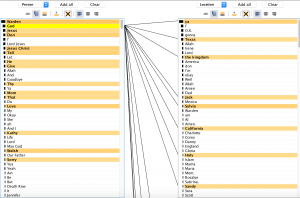
I had very different experiences working with these two different platforms. I thought Voyant was very easy to use. I like that Voyant has a lot of different tools that you can choose from, however there were several that I felt were not useful because they were visually incomprehensible or because they just didn’t provide a valuable organization of the data. I think there are still several very valuable tools and I enjoyed reading through the information breakdown below the visualizations as well. I like Jigsaw because of how different each of the 10 tools are. I think they are extremely valuable in looking at the data from new perspectives and seeing connections you would otherwise miss. There are views similar to Voyant’s tools, but there are also several that are very unique, complex, and interactive. I felt like I had more control.
Finally, creating this corpus and viewing it through Voyant and Jigsaw has affirmed Clement’s observation of this “multidimensional viewpoint”. I was very surprised at how the many different ways I visualized the data shaped my interpretation of the inmates’ last words. Throughout the process, I drew conclusions that I did not come to when I initially read their last words. I was able to better grasp that these data analytics methods make the information more objective and allow you to see the information in its rawest form, but that seeing it in its rawest form created even more complex connections.