For the construction of Steve and I’s corpus, we have decided to take a look at three different religious texts. The Christian Bible, Muslim Quran, and the Hindu Vedas. Looking at these three different texts could show us a simple way of understanding what each book is trying to convey. We also wanted to make different visualizations to represent common ideas and differences between each text. We understand that there could be different interpretations to each book and what they try to convey, so we are going to use textual analysis to take the narrative out of the story and essentially getting the words themselves to convey the message. But using an interactive way of data visualization will allow us to better interpret similarities and differences between the three texts.
For the two images depicted, I took the first two chapters from the Quran and ran them through Voyant. Then I took the Bible and ran it through Jigsaw. These were my results.
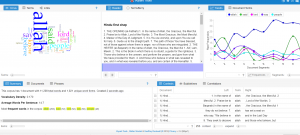
In Voyant, I looked at the first two chapters of the Quran. Looking in the Cirrus, I can already see that “Allah’ is the most frequent word used (253 times). It makes sense for Allah to be seen most often in the Quran. Another interesting aspect to look at is the scatter plot of the most common word usage. Allah continues to rise in how often it is used, followed by “people”, “said”, and “lord”.
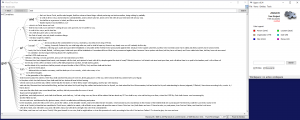
In Jigsaw, it was a little tricky to get to work, but I took a look at the Bible’s first and second testament. The issues that I seem to come across often are quite simply that the program does not exactly work. Whether it is because of my computer being a PC or perhaps the documents I am running through it, the same issue keeps appearing. This issue being selecting certain visualizing tools and having nothing load through. But through seeing the platform work on other’s laptops, I am able to justify that Jigsaw is much more usable when looking at word trends and its “word tree” option. I managed to get the wordtree option to work, which was interesting to look at words that are commonly used in succession of another.
Due to previous experiences with both platforms, I have formed a preference with Voyant. Jigsaw is difficult to use when documents exceed a few thousand words, making it almost impossible to use in certain circumstances without having to breakdown and chunk your texts. Voyant allows for simple input and simple output. What I mean is that the platform is easy to input your data to be analyzed with simple options. Once Voyant runs through your documents, it gives you plenty of options to visualize your data in interactive ways. At one point, Voyant even showed us that pronoun usage in some novels was much more of a prevalent concept to follow than what we were initially investigating. It turned out that male and female authors were more likely to use male characters than female characters. That was for a previous corpus we formed using science fiction novels. Jigsaw can interpret data in ways that are much more thorough, though. When using something like Wordtree, Jigsaw is excellent at looking at different word trends.
When looking at the results of texts run through data visualization tools, you are viewing them in their most realistic and authentic state. The narrative is removed from the document, leaving it as a simplified collection of words. What this does is completely remove any sense of bias that could be present in the work. Tanya Clement’s claim that the use of visualization platforms “… is a virtual reality that keeps us mindful of the processes we use to produce it, but the experience of this encompassing vantage point allows for a feeling of justice or authenticity that is based on plausible complexities, not simplified and immutable truths.”
