Final Artifact: Atlanta: New Wave Timeline
Over the course of the semester, we have gathered files of many songs and characteristics that represent the music and culture of Atlanta, known as the cultural capital of Hip-Hop. ATL has seen it’s decades of greatness which has left an everlasting impact on the musical world. We decided to analyze the two popular eras in Atlanta, which was the Dirty South Era and the TRAP era. There were a few purposes that resulted in us exploring these periods. As world events and different culture waves come and go, it’s normal for individuals to live differently to keep up with society. Does that mean the music will differ? Are these new rappers following in the same footsteps of their ‘elders’ or are they going in a different direction? Where one may be describing their love for a significant other, another could be describing/flaunt how much they paid for a piece of jewelry or exotic car. We both enjoy music a lot as it has helped us express ourselves through others who have the musical talent. There are times where us individuals feel a certain way, but we cannot communicate these emotions clearly. Instead, we keep these thoughts in our mind instead of releasing them. We thought to ourselves “What are these guys actually talking about in these songs?”. It’s quite interesting to see how their life stories are being told through the music. Our favorite genre is ‘trap’ which was created in Atlanta during the 2010s, as the Dirty South Era began to wear off. We wanted to compare these decades through lyrical content as trends and waves came and go. However, the main principles that are found in typical hip-hop music still prevailed. These characteristics were money, women, exotic cars, and superstardom.
The selected songs used in our corpus are popular hit singles that have all went viral and were what we consider ‘defining moments’ in the Atlanta hip-hop industry. We felt that this would give us the most accurate data whereas these lyrics have essentially progressed these movements forward. We collected 57 songs that totaled over 37,900 words in length. A dataset this large requires extensive cleaning to ensure clarity when loading the spreadsheets into platforms. We started this process in Assignment 2 and continued throughout the semester. I’ll be the first to admit that every platform has a learning curve which varies from each visualization program. We used Voyant, Jigsaw, and Palladio and we ran into the majority of our problems with Jigsaw and Palladio. Voyant has always been a powerful tool that allows a viewer to interact with the data as there are many visualization tools to choose from.
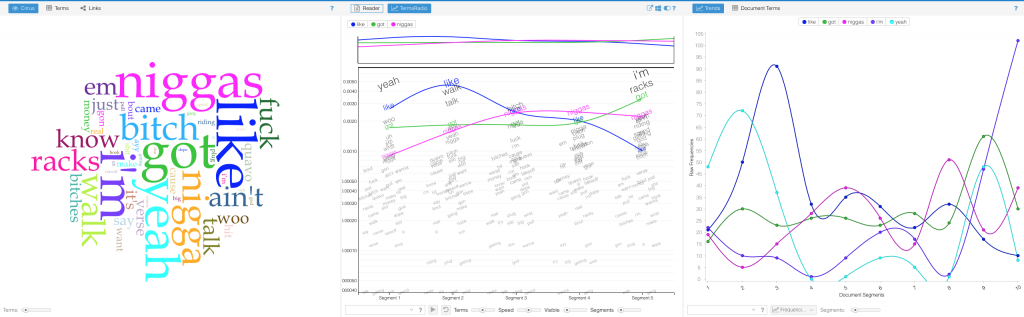
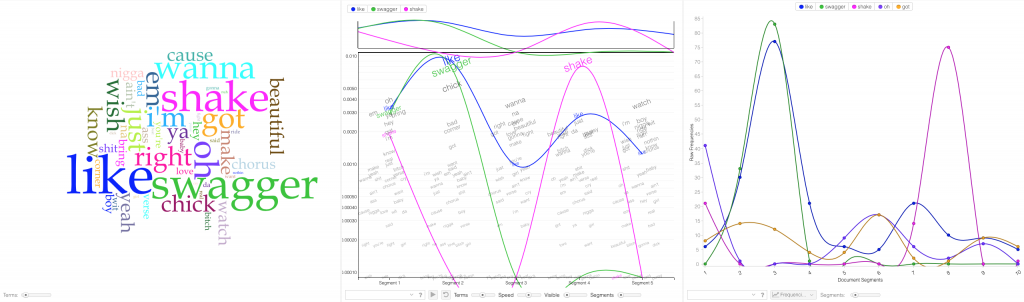
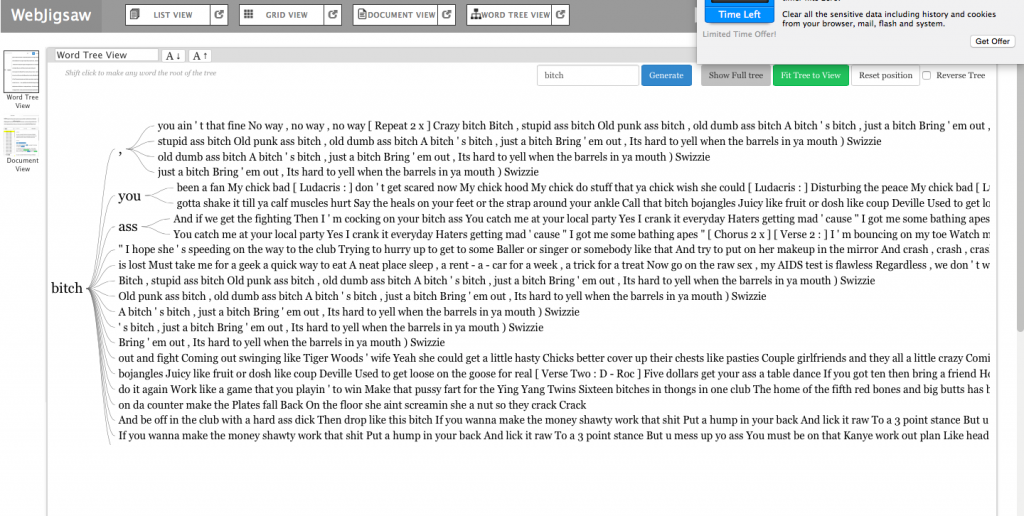
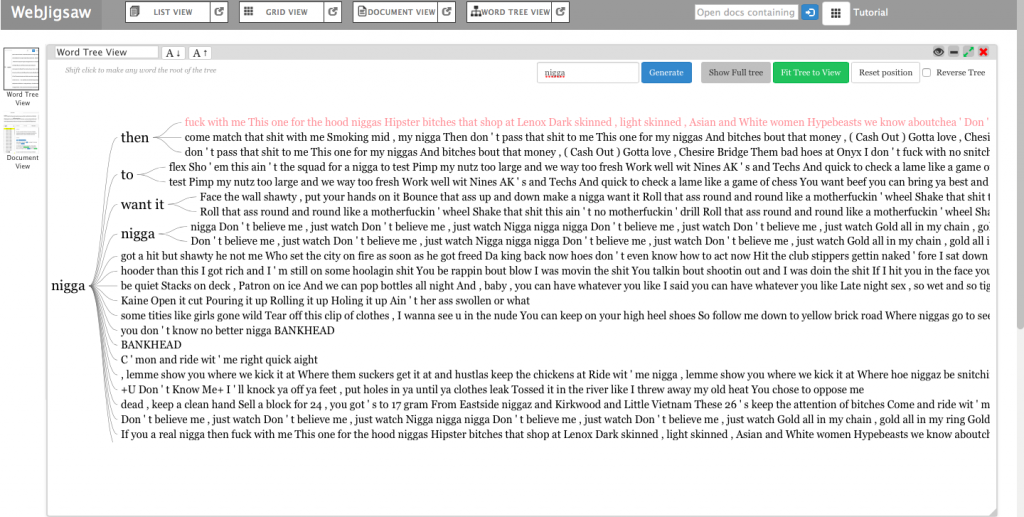
Jigsaw started off our problems with formatting to properly upload the lyrical content data. First, we tried to upload the graph in a .CSV file but it wasn’t properly converted into the proper category. That didn’t work out as it would show as ‘no files found’. However, we found the correct entity to convert our files which ended up solving the problem. After that, Jigsaw was very helpful as the Word Tree tool allowed us to search words and view the phrases that associate with the searched term. The few tools in this program prohibited us from making a variety of visualizations. In the Drucker reading, it discussed how a viewer could take away lessons from “galleries of good and bad, best and worst…they are useful for teaching and research”(Drucker, 239). With the visuals that we deemed good and bad, we both learned from them despite the physical appearance. After all, not all maps have to be flashy, but they must be meaningful. We searched n***** and b**** because those words were constantly appearing within the lyrical corpus data. Ultimately, it helped us understand lyrical phrase combinations that revealed a significant focus between the two eras. In the 2000s, rappers were including women at a high rate in their verses. This showed the persona of these artist being that they were idolizing females and the lifestyle that comes with a lot of girls. In 2010, the focus shifted more to money and groups. We concluded that musical platforms like Spotify, Apple Music, and Tidal have given the artist a more efficient tool to reach an audience. This has improved the financial gain throughout the industry which has encouraged more Atlanta rappers to launch their careers.
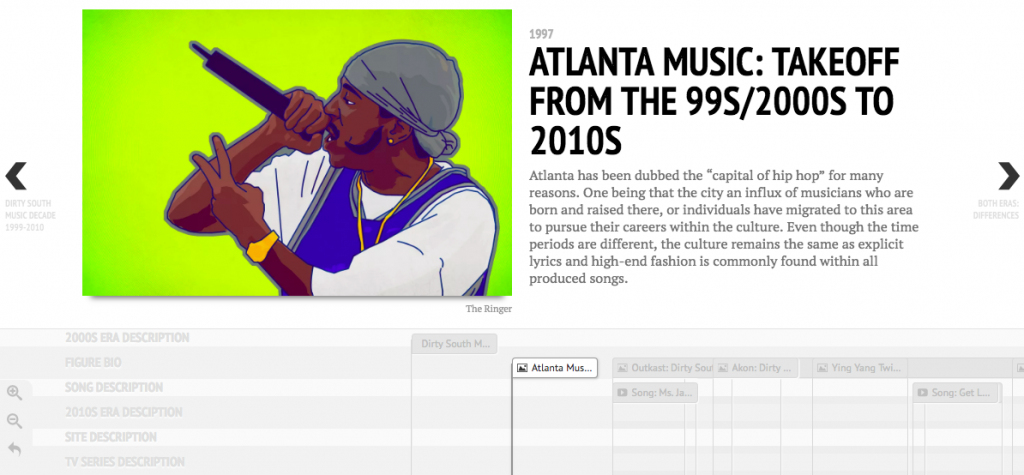
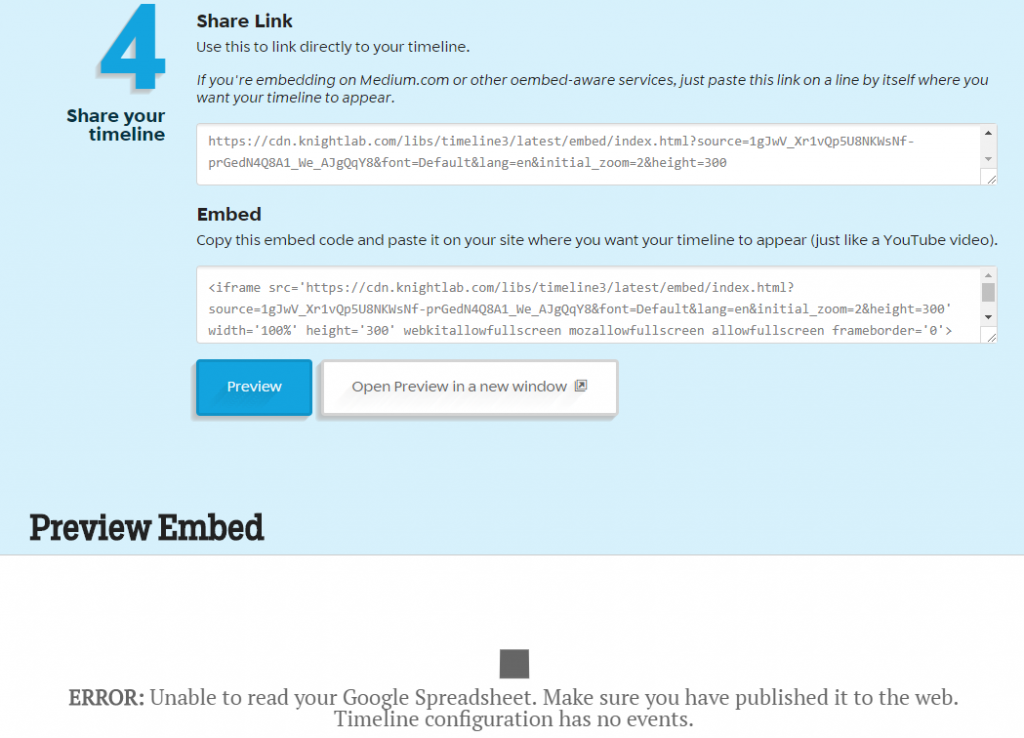
Using Timeline JS, we also ran into minor formatting problems with creating a proper timeline. The fourth step of sharing the google doc link wasn’t valid. However, we corrected the problem and previewed our corpus on the timeline preview. After multiple editing sessions, we created a complete project that included music summaries, videos, genre descriptions, etc. It was great to see our hard work paying off onto an interesting visual. Some may say that this isn’t important because you could see this information drawn up in a quick sketch by an individual. I don’t agree with that because visualizations “provide us with a new perspective on texts that continue to compel and surprise us by being so provocative and complex — so human.” (Clement 12) Seeing problems mapped on a timeline can help an audience understand why events occur after past experiences
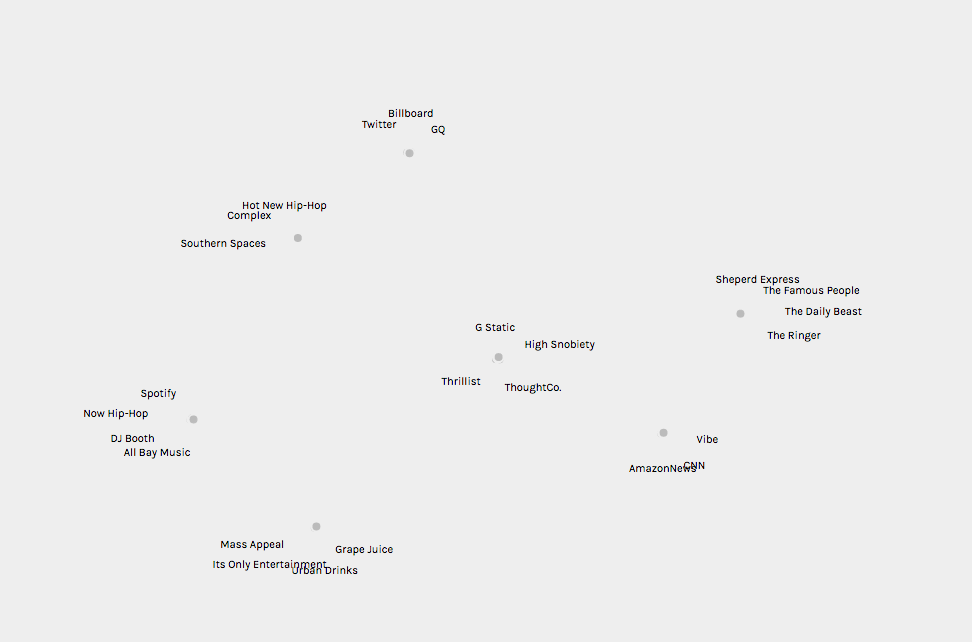

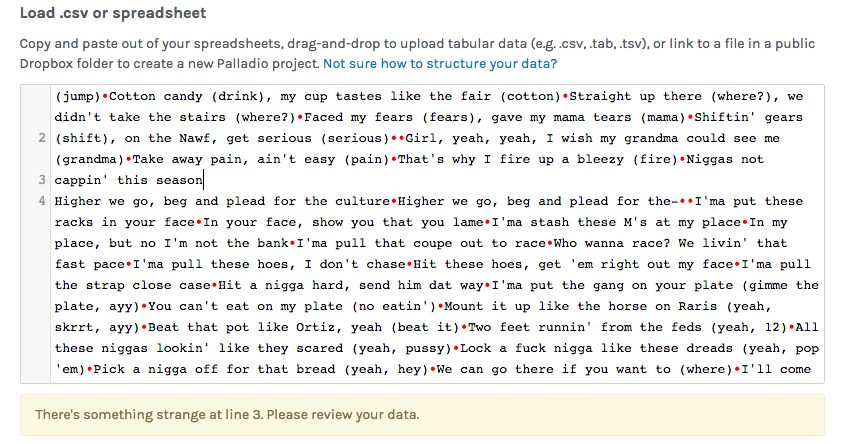
As we started loading our .csv spreadsheet onto the Palladio data, we kept getting an error message saying that ‘something strange’ was occurring within the lines. We had to go through and apply spaces to properly format the corpus data. This helped as the data became viewable and we began using the visualization tools, Graph, and Table, in order to compare Artist Headline to Text Summary and link media outlet relations together. This showed a concise visual of an artist and a quick summary of them. Also, we were able to see the connections between media outlets that supplied our data. For example, Twitter, Billboard, and GQ has a social media presence in society. These sites allow a viewer to be updated with their favorite artist. These tools were very effective in our studies as we found more similarities between the decades and their content.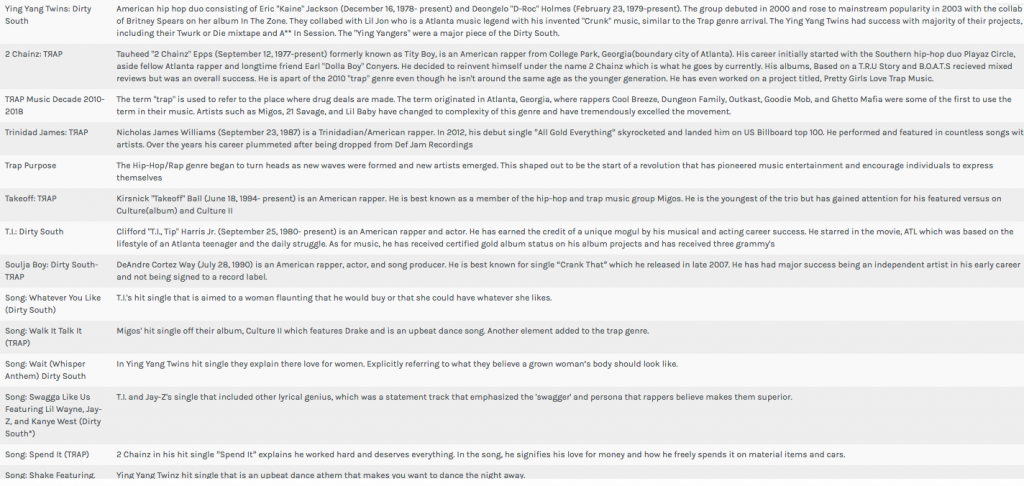
In conclusion, I feel that this project was very successful as it presented obstacles and we found the solutions to make our final project work. Our results solved the research question that was created in the early stages of the project. The hip-hop industry has evolved into many different lanes that has allowed for many individuals to prosper, especially those people who were born and raised in Atlanta. Lyrical content has shifted slightly, however the two decades used many of the same words and phrases.However, the focus shifting from women to money was interesting to see as the rise of ‘trap’ music has allowed rappers to be booked for shows all across the nation. One thing for sure, times may change but the future is always imitating parts of the past. We believe it’s a great thing as both generations can enjoy the music together and express themselves like never before.
Palladio: [Table] Artist Headline to Text Summary
Struggles mentioned earlier:
Bibliography
“Song Lyrics & Knowledge.” Genius, genius.com/.
Carmichael, Rodney. “Culture Wars.” NPR, NPR, 15 Mar. 2017, www.npr.org/sections/therecord/2017/03/15/520133445/culture-wars-trap-innovation-atlanta-hip-hop.
Clement, Tonya. “Text Analysis, Data Mining, and Visualizations in Literary Scholarship”. book
Drucker, Johanna. “Graphic Approaches to the Digital Humanities” ch. 17. book
Jordan, Mike. “The 14 Most ‘ATL’ Songs Ever Recorded.” Thrillist, Thrillist, 4 Dec. 2015, www.thrillist.com/lifestyle/atlanta/the-14-most-atlanta-songs-ever-made.
Miller, Matt. “Dirty Decade: Rap Music and the US South, 1997–2007.” Southern Spaces, 10 June 2008, southernspaces.org/2008/dirty-decade-rap-music-and-us-south-1997%E2%80%932007.
Wilcox, Andrew. “‘The Impact of Trap Music on the Greater Atlanta Community.’” Lower Division Studies, 1 Dec. 2017, lds.gsu.edu/news/showcase/atlanta-studies/andrew-wilcox/.
Williams, Stereo. “How Atlanta Became the New Cultural Capital of America.” The Daily Beast, The Daily Beast Company, 29 Jan. 2017, www.thedailybeast.com/how-atlanta-became-the-new-cultural-capital-of-america.
