For our data visualization project, Katie and I analyzed religious texts to unveil the potential similarities and differences between them. Thus, our corpus is constructed of the Christian Bible, Muslim Quran, and the Hindu Vedas. The digital text of the Bible was available for us with the installation of Jigsaw. For the Quran, our professor had a digital text version of it on hand and shared it with us for our research. The Hindu Vedas is the only missing piece of text we do not have in our corpus at this time. I do not believe this will be problematic because simply Googling “Hindu Vedas,” we are met with multiple search results for PDF versions. I only have to download and look through a few samples to make sure they can be processed and do not have too many errors.
(For clarity, I will be using Voyant for the Quran and Jigsaw for the Bible in the image examples below)
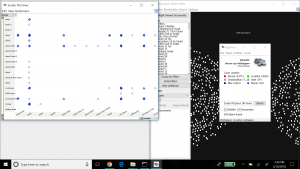
Here is an example of using the Scatterplot tool in Jigsaw. The two axes show words that connect with each other. I noticed that this view presents a few repeat words connecting with each other, which adds little value to our research (example: “Jesus” connects with “Jesus”). The concept of the Scatterplot tool however does seem promising.
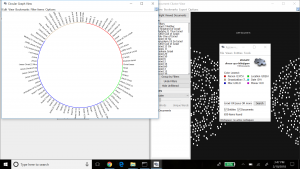
This is the Circular Graph tool. I liked the interactiveness of this tool. When clicking on one of the entities, connections to other entities are automatically displayed (on the outer rim of the circle). This provides an easy way for researchers to visualize the connectivity between an entity and other entity groups. The same “repeat words” problem that we saw with Scatterplot appeared with this tool also. I think both of these tools would be especially helpful if the user makes their own custom entities. I noticed though while using these tools that Jigsaw did not have discreet grouping, which resulted in self-connectivity. This made it a bit harder to identify real connections.
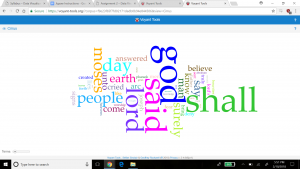
Voyant’s Word Cloud tool produced these results. The Word Cloud tool offers researchers a fast approach to understanding key messages in a text, simply because it shows by size the words most used. It does not require intensive effort to understand the results – with just a glance, users quickly see the major points by observing the largest words. Looking at the cloud, it is not surprising that two words that refer to Allah are especially prevalent (“Lord” and “God”). However, I did find it surprising that an important biblical figure, Moses, appears many times in the religious text as well.
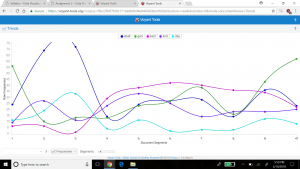
The Trends tool helped me identify something peculiar. “Shall” was used extensively more than any other word in the beginning, but it eventually died down to “normal” frequency. I think this highlights the usefulness of this tool. If I was close reading the Quran, I likely would not have noticed the changing frequency of “shall” in the text, but the Trends tool visualizes this deterioration quite nicely. For users whose research depends on examining word trends, this tool will prove indispensable.
I think Jigsaw and Voyant are exceptionally useful tools for data visualization. Personally, I like the concepts in Jigsaw better than Voyant, because they seem more rich and intuitive to me, but the “self connection” error is a major drawback. Although Voyant shows easier to understand data visualizations, it does not offer as much information as the tools embedded in Jigsaw. Most of Voyant’s results can be summed up as a word frequency visualization. Jigsaw shows connections between words in more ways than Voyant can, which may help researchers iterate and extend their investigation.
My process of corpus construction and data visualization through Voyant and Jigsaw verify Tanya Clement’s observation. This is because I can appreciate how the different ways I approach my queries can shape the result of any data visualization. Data visualization is indeed a varied and complex process, offering up a rich set of observations any researcher can jump on as results are presented. This is an interesting contrast to the research process anchored in surface reading a piece of text, which seems far more non-iterative in comparison.
